
From raw footage to videos every week
An editing pipeline for three bouldering gyms that filmed everything and published almost nothing.
- Client
- Réglette
- Sector
- Bouldering gyms
- Place
- Brussels, Liège and Namur, Belgium
The problem
Setters filmed every new problem, coaches filmed classes, and competitions were filmed from every angle. The files stayed on personal phones. Each gym posted its own way, with no subtitles, and the competition video came out once nobody was talking about it any more.
SymptomsStudio concept
We have hours of footage on our phones and nothing ever comes out.
Each gym posts its own way; it doesn’t look like the same brand.
The competition video comes out two weeks later, when everyone has moved on.
The cause
Nobody owned the editing
Filming was part of everyone’s job; editing was part of nobody’s. With no intake and no file-naming rule, footage got lost before it was even sorted.
Every video started from scratch
No recurring format, no ready-made titles or end cards, no cleared music. Every edit went back over hours of decisions already made the week before.
The wrong format for the right audience
Long videos on feeds that scroll, no subtitles although people often watch with the sound off, and a single language in a city that speaks two.
What we build
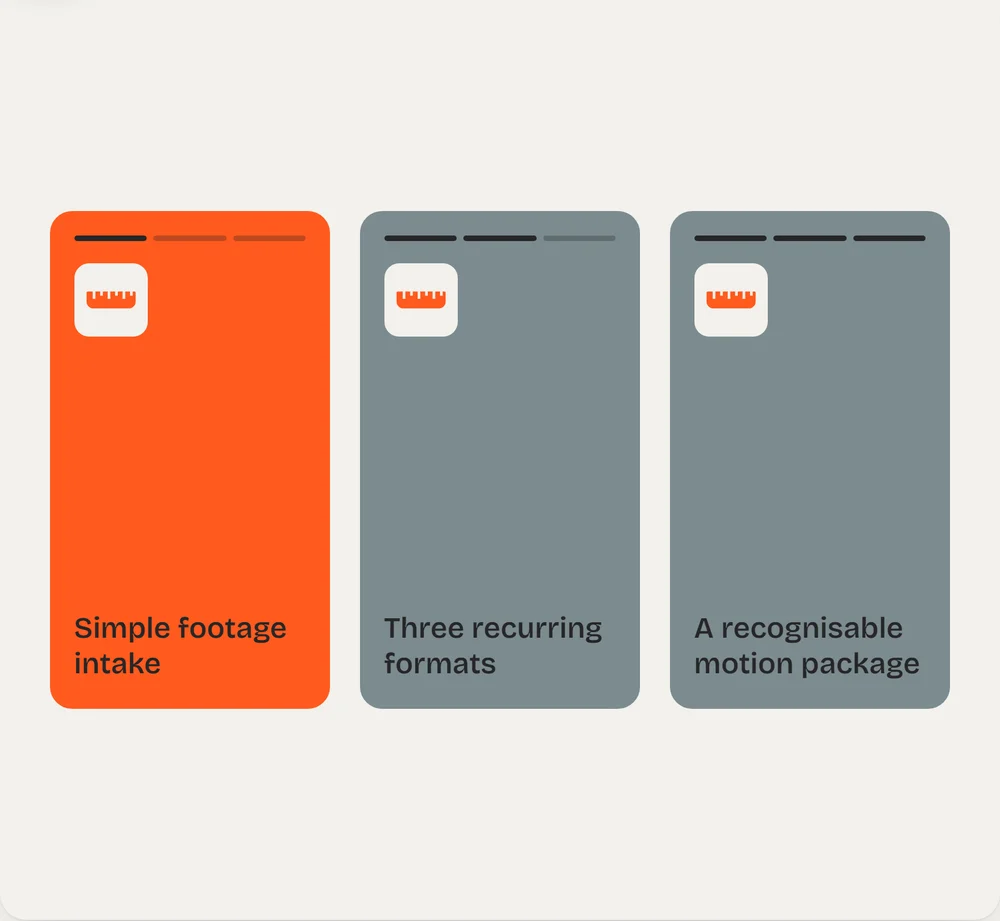
Simple footage intake
One shared folder per gym, a file-naming rule and a one-page shooting sheet for setters: frame wide, film the start, keep the sound of the fall.
Three recurring formats
The week’s new problems in vertical format, the competition recap in under forty-eight hours, and one long video a month on a setter or a project.
A recognisable motion package
Titles, grades, end cards and a ruler-shaped progress bar, in the colours of each gym’s circuits.
Subtitles in French and Dutch
Every video comes out subtitled in both of Brussels’ languages, short for feeds and long for YouTube.
Previews
Drawn in code from the study’s identity: logo, mark and palette. No photography, no AI-generated images.
- 01Taking stock
- 02Setting the formats
- 03Producing weekly
- 04Archiving
How we would work
01Taking stock
Sorting existing footage and spotting what can be used right away.
02Setting the formats
Lengths, structures, music and motion package agreed on the first three videos.
03Producing weekly
Editing and subtitles every week from the shared folder, signed off by one person per gym.
04Archiving
Every useful clip is filed by gym, problem and date, ready to reuse in end-of-season videos.
What would change
- Videos come out at the same pace as the new problems.
- The three gyms read as one brand, each with its own circuit colours.
- Setters film for a specific format instead of filming just in case.
What we would measure
- Time from shoot to publication
- Videos published per gym per month
- Completion rate of short formats
- New members who mention a video when signing up
Measures to track, with no values: a concept has no results.
A problem like yours?
Describe it in a few lines. We reply with our questions, or a time to talk it through.
Discuss this service