
IT that no longer depends on one person
An IT overhaul for a health centre whose network, backups and access depended on one relative’s goodwill.
- Client
- Maison de santé Quinconce
- Sector
- Multi-professional health centre
- Place
- Vosges, eastern France
The problem
IT had been set up bit by bit as people joined, by one of the doctors’ sons. Nobody knew which computers existed, who had access to what, or whether the medical software’s backups worked. Patients and staff shared the same Wi-Fi.
SymptomsStudio concept
Our IT is one of the doctors’ sons, when he has the time.
We don’t know whether the backups work, and we’d rather not check.
When the reception printer breaks down, the whole morning falls apart.
The cause
No inventory
With no list of equipment, accounts and access, nobody could tell what to protect, replace or shut down when someone left.
Backups never tested
A backup that has never been restored is only an assumption. With health data and a network open to patients, ransomware would have brought the centre to a halt.
No path for breakdowns
Every problem went to one person, unpaid and busy. Nothing was written down: no procedure, no contacts, no response times.
What we build
Inventory and access map
Every computer, account and piece of software listed, with an owner, a warranty end date and a leaver procedure.
A partitioned network
Patient Wi-Fi isolated from staff Wi-Fi, and clinical workstations on a network of their own.
Tested backups
Automatic copies on site and off site, and a restore test every month, logged. Health data stays with a host certified for French health data (HDS).
Secure access
A password manager, two-factor authentication and automatic updates on every machine. Healthcare professional cards and their readers are on the inventory.
Support with rules
One entry point for requests, written response times and an incident procedure posted at reception.
Previews
Drawn in code from the study’s identity: logo, mark and palette. No photography, no AI-generated images.
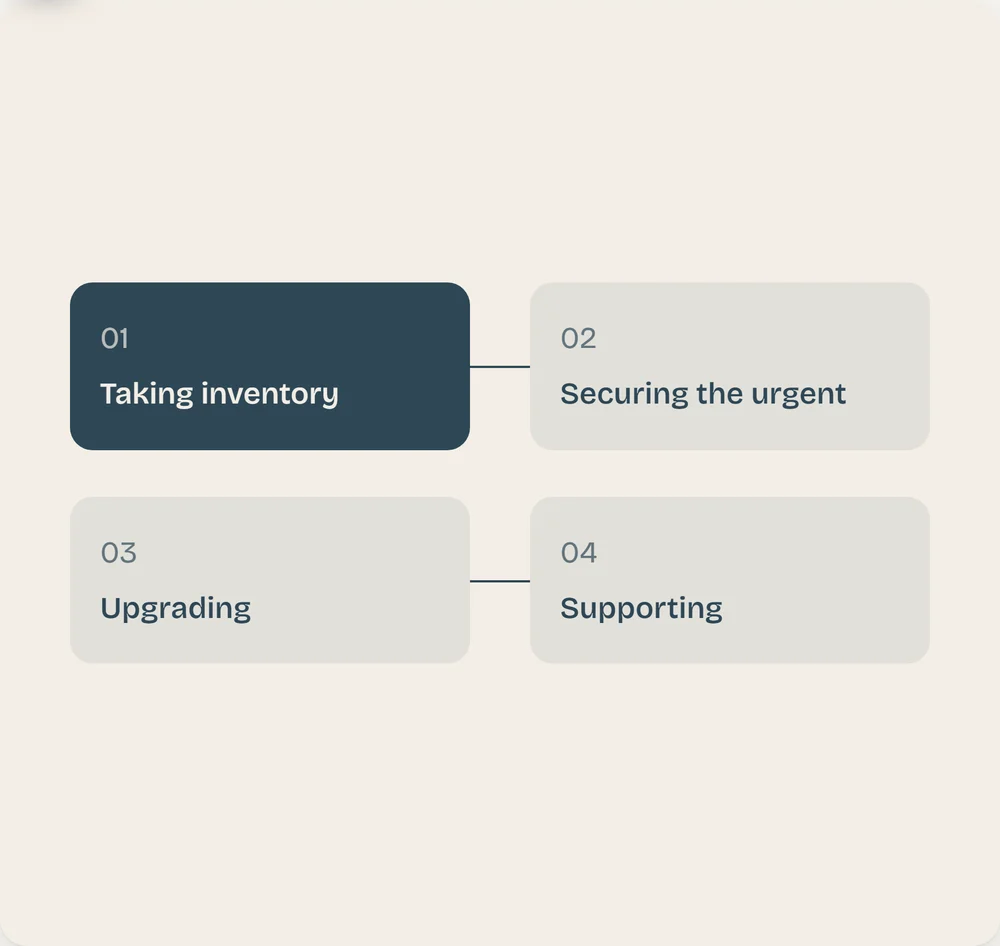
- 01Taking inventory
- 02Securing the urgent
- 03Upgrading
- 04Supporting
- Inventory and access map
- A partitioned network
- Tested backups
- Secure access
How we would work
01Taking inventory
A day on site, outside consultation hours, to list equipment, accounts and connections.
02Securing the urgent
Backups checked and restored first, then the networks separated.
03Upgrading
Computers replaced or reinstalled from a common image, with a named account for everyone.
04Supporting
A monthly support contract, with a quarterly review and documentation kept up to date.
What would change
- The centre knows what it owns and who has access to it.
- Restoring a backup is a tested routine, no longer an assumption.
- A breakdown follows a procedure instead of depending on a relative.
What we would measure
- Results of the monthly restore tests
- Share of computers up to date
- Accounts protected by two-factor authentication
- Support requests per month and time to resolution
Measures to track, with no values: a concept has no results.
A problem like yours?
Describe it in a few lines. We reply with our questions, or a time to talk it through.
Discuss this service