
Rules before tools
An AI consulting engagement for an accountancy firm where AI was already in use, with no rules, on client data.
- Client
- Partie Double
- Sector
- Chartered accountancy
- Place
- Rennes, Brittany
The problem
Several staff were using consumer assistants, sometimes with clients’ bank statements and payslips. The partners received offers for “AI-powered” tools every week with no way to compare them. Meanwhile, chasing missing documents took up much of the tax season.
SymptomsStudio concept
Part of the team already uses ChatGPT, with client data in it.
We get offered an AI tool a week, and I can’t tell which ones are worth anything.
Chasing clients for their documents is what eats up our tax season.
The cause
Use without a framework
No list of approved tools, no rule on what data can go into them. Professional secrecy and GDPR were exposed without anyone having decided so.
Nobody knew where the time went
With no task map, every tool pitch was judged on its demo. Nobody could say whether a tool solved one of the firm’s real problems.
Tools bought before the process
An earlier trial had failed because documents arrived in a jumble, by e-mail, as photos and on paper. No tool makes up for a messy intake.
What we build
A usage audit
Interviews with each team: which tools, for what, with which data. The result fits on one page the partners actually read.
A usage policy
Approved tools, forbidden data, mandatory human sign-off before anything goes to a client, and an incident log.
A task map
Each recurring task scored on time spent, possible gain and risk. It filters every tool offer to come.
A pilot: chasing documents
Working from the general ledger, the tool drafts the list of missing documents and a reminder; a member of staff signs off before each one is sent. The data stays in an environment hosted in Europe.
Training by role
Two sessions per team, on their own anonymised files: what the tool does well, and what must never be handed to it.
Previews
Drawn in code from the study’s identity: logo, mark and palette. No photography, no AI-generated images.
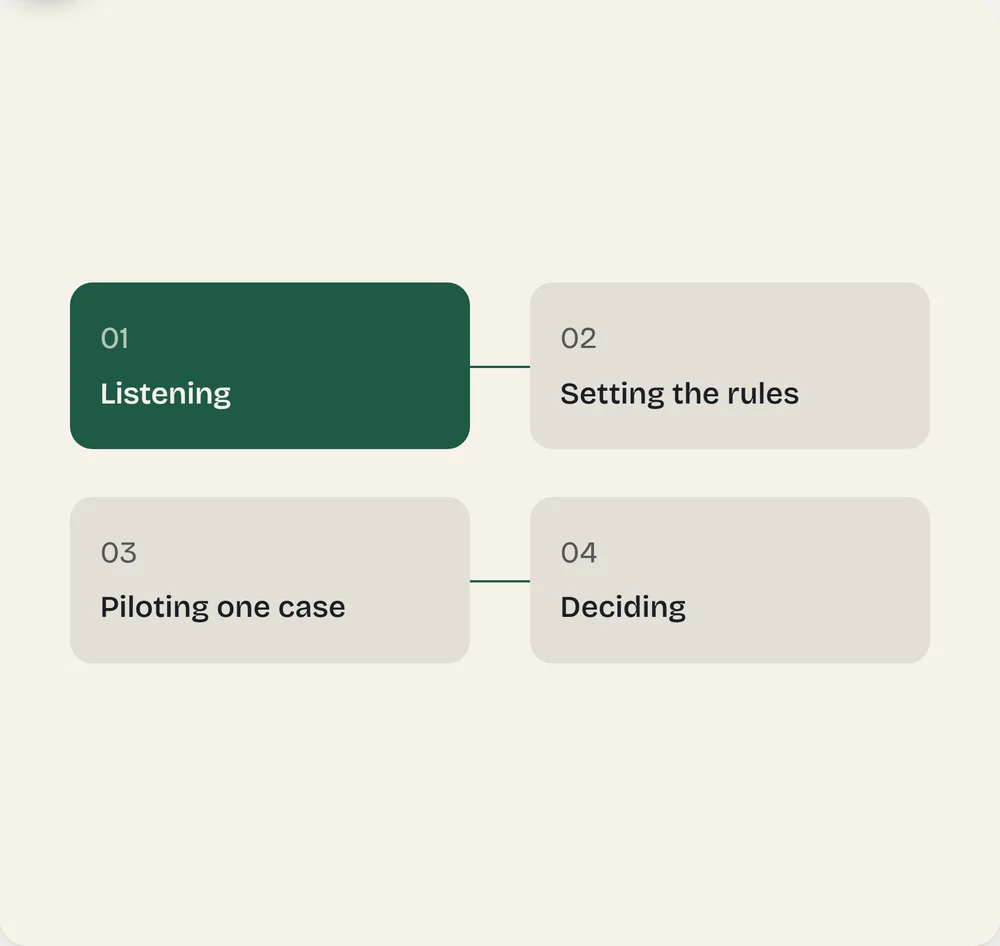
- 01Listening
- 02Setting the rules
- 03Piloting one case
- 04Deciding
- A usage audit
- A usage policy
- A task map
- A pilot: chasing documents
How we would work
01Listening
One-to-one interviews and a week of work observed in the middle of tax season.
02Setting the rules
The usage policy approved by the partners before any new tool.
03Piloting one case
Document chasing measured before and then during the pilot, on a portfolio of volunteer clients.
04Deciding
A review after a few months: extend, fix or stop, with the evidence on the table.
What would change
- Everyone knows which tools to use and which data never to put into them.
- Tool offers are weighed against a task map rather than a demo.
- Document reminders go out earlier and more regularly, always signed off by a member of staff.
What we would measure
- Hours spent each month chasing documents
- Average client response time to reminders
- Share of staff trained
- Incidents and near misses recorded in the log
Measures to track, with no values: a concept has no results.
A problem like yours?
Describe it in a few lines. We reply with our questions, or a time to talk it through.
Discuss this service