
Selling online what already sells in shops
An e-commerce brand rebuilt for a skincare range that sold well in sports shops and barely at all on its own site.
- Client
- Adret
- Sector
- Skincare
- Place
- Annecy, French Alps
The problem
On the shelf the products did well, recommended by shop staff. Online, with no one to advise them, visitors saw a list of ingredients and sizes. Sales bunched up in winter, pulled along by discount codes, and customers didn’t come back.
SymptomsStudio concept
In shops our creams sell themselves. On our own site, almost nothing.
We run a promotion every month, otherwise nothing happens.
People buy a balm in December and we never see them again.
The cause
Products named for the lab
Names and product pages talked about active ingredients and sizes. Customers look for care for a situation: a day of ski touring, a windy trail run, a day above two thousand metres. With no one to translate, they don’t choose.
A season held up by discounts
The range had been designed for the cold. With no summer product in the spotlight, the warm months were filled only with discount codes, which taught customers to wait for the next one.
Nothing after the first order
No refills, no post-purchase sequence, no reminder when the tube runs out. The brand let customers go at the very moment they were most satisfied.
What we build
A range organised by situation
Three families that speak the way customers do: Facing the cold, Facing the wind, Facing the sun. Ingredients move to second place, inside each product page.
Packaging with refills
Aluminium jars kept from one season to the next, and pouch refills sent by post at the right moment.
A store that advises
A three-question choice guide replaces the shop assistant’s advice; kits by activity work as gifts and as a first order.
E-mails that follow use
A post-purchase sequence: how to apply, when to reorder, what to pack for summer. Discounts become the exception.
A kit for shops
A display, staff cards and a QR code to the choice guide, so that the shop and the site say the same thing.
Previews
Drawn in code from the study’s identity: logo, mark and palette. No photography, no AI-generated images.
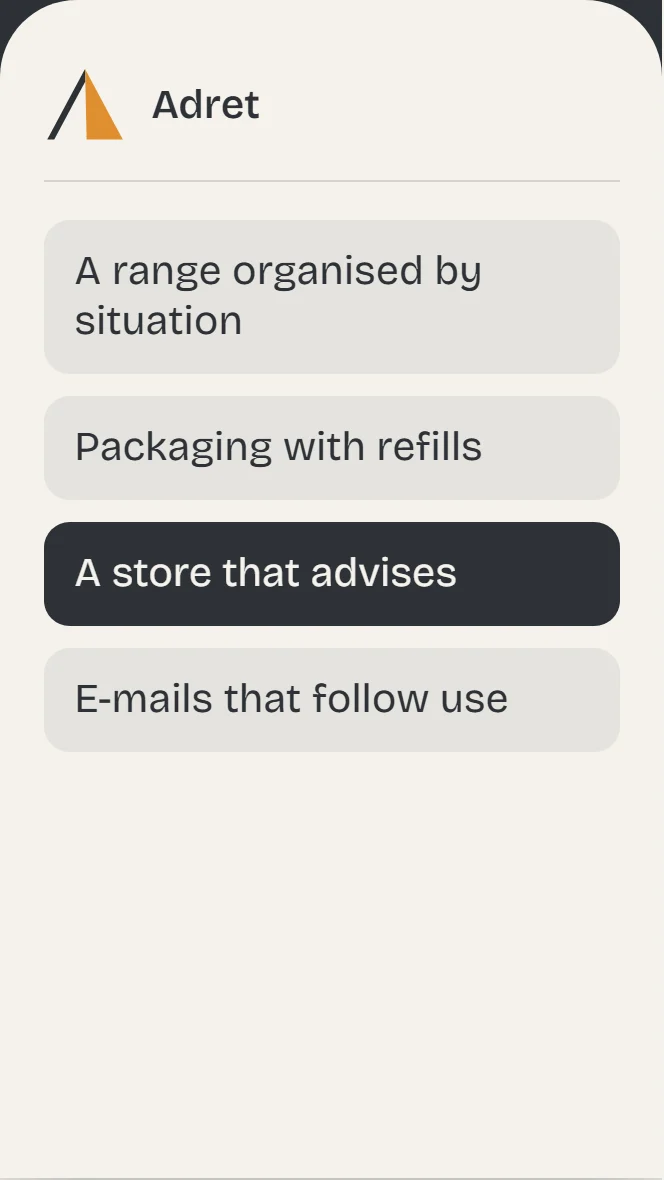
- A range organised by situation
- Packaging with refills
- A store that advises
- E-mails that follow use
How we would work
01Listening to shop staff
A day in two partner shops, to hear how staff present the products and what customers ask.
02Renaming
A new range architecture, names and copy, tested with existing customers before any packaging change.
03Building the store
Product pages, choice guide, kits and e-mail flows, live before the summer season.
04Tracking reorders
A monthly check on refills, returns and sales outside winter.
What would change
- The site advises like a shop assistant: people choose by situation, not by ingredient.
- Summer has its own range and message; discount codes no longer carry the year.
- The first order opens a relationship: refill, reminder, seasonal advice.
What we would measure
- Reorder rate at three months
- Average order value and share of kits
- Share of revenue made outside the winter season
- Conversion rate of visitors who used the choice guide
Measures to track, with no values: a concept has no results.
A problem like yours?
Describe it in a few lines. We reply with our questions, or a time to talk it through.
Discuss this service